
You climb into bed at a reasonable hour. You log your seven or eight hours. And yet you still wake up foggy, reach for that second cup of coffee by mid-morning, and lose the word you were just about to say. If that sounds familiar, the problem may not be how long you sleep. It may be how well your brain is working while you do.
At TIFAAR, we spend a lot of time helping women and men in The Woodlands and Spring understand the difference between feeling “fine for your age” and feeling genuinely sharp, rested, and like yourself. Sleep is one of the most overlooked pieces of that picture, and the link between sleep and brain health is stronger than most people realize. So let’s talk about what really happens in your head overnight, why it changes after 40, and what you can do to support it.
Your Brain Cleans House While You Sleep
Here is something most people never learned: your brain has its own overnight cleaning crew.
While you sleep, a network called the glymphatic system flushes cerebrospinal fluid through your brain tissue and washes out the waste that builds up during a busy day. Researchers at the University of Rochester first described this process in detail, and what they found was striking. During deep sleep, the tiny spaces between your brain cells open up significantly, letting that fluid move through more freely and carry waste away (learn more from the original research in Science).
Two of the waste products this system clears are beta-amyloid and tau, the same proteins that accumulate in the brains of people with Alzheimer’s. In other words, a good night of deep sleep is one of your body’s natural ways of keeping the brain tidy. Cut that process short, and the cleanup stays unfinished.
That’s the core idea worth holding onto: total hours tell you how long you were in bed. Sleep quality tells you whether your brain actually got cleaned.
The Two Shifts That Matter Most
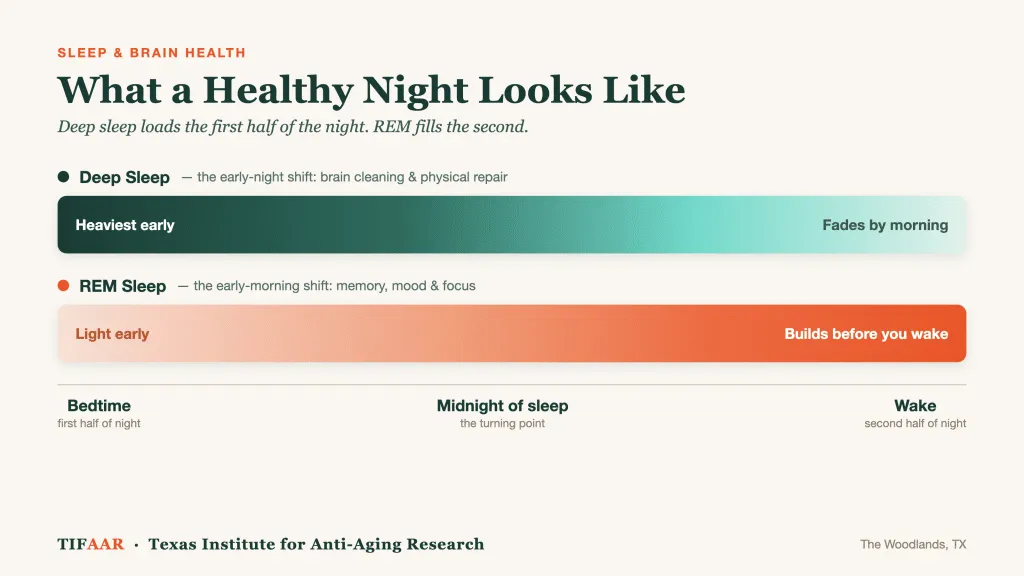
Not all sleep does the same job. Across the night your brain cycles through different stages, but two of them carry most of the weight for healthy aging.
Deep sleep (the early-night shift). This is your physical and neurological repair window. It’s when that glymphatic cleaning runs most efficiently, when your body releases the bulk of its natural growth hormone, and when tissue recovery and immune work happen. Deep sleep is heaviest in the first half of the night, which is exactly why a late bedtime quietly robs you of it.
REM sleep (the early-morning shift). This is your brain’s filing system. REM consolidates memories, sorts through emotions, and trims unused mental connections so the important ones stay strong. It clusters in the second half of the night, which means cutting your sleep short on the back end, with an early alarm, shortchanges your REM.
Both shifts protect your brain in different ways. You need the full night to get both.
Why This Changes After 40 (And the Hormone Connection)
Here’s the part your annual physical probably skipped.
Deep sleep naturally declines with age. A person in their twenties spends a generous chunk of the night in deep sleep; by the time we reach our fifties and sixties, that window has shrunk dramatically. Some of that is simply biology. But a large share is driven by factors you can actually influence, and for women, hormones sit near the top of that list.
As estrogen and progesterone decline through perimenopause and menopause, sleep often becomes lighter and more broken. Night sweats jolt you awake. Racing thoughts make it hard to settle. Progesterone, in particular, has a calming, sleep-supporting effect, and as it falls, deep sleep frequently goes with it. Add the elevated cortisol that comes with chronic stress, and the body struggles to drop into the slow, restorative depths where brain cleaning happens.
There’s a knock-on effect, too. Because so much of your natural growth hormone is released during deep sleep, less deep sleep can mean less of the overnight repair that keeps you feeling strong and recovered. It becomes a frustrating loop: shifting hormones disrupt your sleep, and disrupted sleep undercuts the very recovery your body is trying to do.
This is precisely the kind of root-cause connection we look at with our patients. When someone tells us they’re exhausted no matter how much they sleep, we don’t shrug and call it normal aging. We look at what’s actually happening underneath.
What Quietly Steals Your Deep Sleep
Before reaching for anything clinical, it’s worth knowing the everyday habits that erode sleep quality. A few of the biggest culprits:
Alcohol in the evening. A glass of wine may help you fall asleep, but it suppresses deep and REM sleep and fragments the second half of your night.
A bedroom that’s too warm. Your core temperature needs to dip slightly for deep sleep to take hold. A cool, dark room helps it happen.
Late, inconsistent bedtimes. Going to bed late skims deep sleep off the top; an early, jarring alarm clips REM off the end.
Untreated sleep apnea. Repeated nighttime arousals fragment your sleep and pull you out of the deep stages, and it often goes undiagnosed, especially in women.
Certain sleep aids. Some common sedatives help you stay asleep but can blunt the restorative stages you’re actually after. Always review medications with your physician.
Chronic stress. Elevated cortisol keeps your nervous system in “alert” mode and blocks the slide into deep sleep.
How to Protect Your Brain’s Nightly Repair
The encouraging news is that sleep quality is one of the most modifiable factors in healthy aging. A few high-impact habits:
Anchor your bedtime. Going to bed and waking at consistent times protects both deep sleep and REM. Protecting the early-night hours matters most for deep sleep.
Cool it down. Aim for a cooler bedroom and avoid hot baths or heavy exercise right before bed.
Move your last drink earlier. Give your body several hours between alcohol and sleep, or skip it on nights you want true recovery.
Get morning light and daytime movement. Both strengthen the natural rhythm that drives deep sleep at night.
Take persistent fatigue seriously. If you’re sleeping enough hours but still wake unrefreshed, that’s a signal worth investigating, not ignoring.
Where TIFAAR Fits In
For many of our patients, especially women going through perimenopause and menopause, better sleep habits help but don’t fully close the gap, because the underlying issue is hormonal.
That’s where a deeper look pays off. At TIFAAR, every patient starts with comprehensive baseline lab testing so we can see what’s actually driving the symptoms. From there, our physician-led team, guided by board-certified physician Dr. Joseph Perlman, may use:
Hormone optimization, including bioidentical hormone therapy, to address the estrogen and progesterone decline that so often disrupts sleep and helps support more restful nights.
Growth-hormone-supporting peptide protocols, such as sermorelin and ipamorelin, which work by encouraging your body’s own natural growth hormone production, the same process that peaks during deep sleep.
These aren’t one-size-fits-all shots. They’re personalized, medically supervised protocols built on your labs, your symptoms, and ongoing monitoring, designed to support healthy aging from the inside out. Our goal is simple: help you feel rested, clear-headed, and like yourself again.
Does getting eight hours of sleep mean my brain is protected? Not necessarily. The number of hours matters, but the quality of those hours, specifically how much deep and REM sleep you get, is what determines how well your brain repairs and clears waste overnight.
Can hormone changes really affect my sleep that much? For many women, yes. Declining estrogen and progesterone are closely tied to lighter, more interrupted sleep during perimenopause and menopause. Identifying and addressing that hormonal shift is often a turning point.
I sleep through the night but still feel exhausted. What’s going on? That’s a common and important clue. It can point to poor sleep quality, undiagnosed sleep apnea, hormonal imbalance, or a combination. Baseline lab testing helps us pinpoint the cause rather than guess.
Do peptides or hormones cure or prevent Alzheimer’s? No. No therapy can claim to prevent or cure Alzheimer’s, and we’d be skeptical of anyone who says otherwise. What we focus on is supporting healthy aging and the restorative sleep your brain relies on, using evidence-informed, physician-supervised care.
Ready to Sleep Deeper and Feel Sharper?
If you’re in The Woodlands, Spring, or anywhere in the greater Houston area and you’re tired of being told your fatigue and brain fog are “just aging,” let’s take a real look at what’s going on.
Call TIFAAR at (346) 443-8165 or schedule your consultation today. We’ll start with the data and build a plan that’s genuinely yours.
Medical Disclaimer: This article is for educational purposes only and does not constitute medical advice. Hormone optimization and peptide therapies, including sermorelin and ipamorelin, are prescribed by physicians for wellness and hormone optimization purposes. Many peptides are prescribed off-label, and these statements have not been evaluated by the FDA. These therapies are not intended to diagnose, treat, cure, or prevent any disease, including Alzheimer’s. Individual results vary and are not guaranteed. Always consult a qualified healthcare provider before beginning any therapy.