
Free Educational Guide · TIFAAR
Why we age — and how to age better
A plain-English guide to the science of aging, written by Dr. Joseph Perlman — Plastic Surgeon and Regenerative Medicine Physician. Understand what drives aging in your cells, and the habits and tests that can help you age well.
Where This Starts
We’re living longer — but not healthier
In 1950, Americans lived to about 68. Today we reach our early 80s — yet diabetes, heart disease, obesity, and neurologic disease keep rising. The common thread behind them is chronic inflammation. Researchers coined a word for how it speeds up aging: “Inflammaging.” This guide explains what it is and how to lower it in your own life.
10,000
Baby Boomers turn 65 every day in America
25%
of aging comes from the genes you inherited
75%
comes from your environment and lifestyle
Genetics 101
It all starts with your DNA
Every cell in your body holds DNA — four building blocks called A, C, T, and G, arranged in base pairs (A always with T, C always with G). Each cell holds about 6 feet of DNA. Multiply that across roughly 36 trillion cells and each person carries around 36 billion miles of DNA inside them.
Those base pairs form more than 3 billion pairs across your 20,000 genes — your genome — carried on 23 chromosomes from your mother and 23 from your father. Less than 1% of genes differ between people, and that small difference gives you your distinct features, like eye, skin, and hair color. That is your phenotype. Genes make proteins, the basis for every cellular function — and 70% of your protein lives in your muscles.
Gene expression is how a gene gets switched on inside a cell to make RNA and then proteins. Every step from DNA to RNA to protein is a control point — the cell decides which proteins to build, and how many. That switching is where aging gets interesting.
Epigenetics
Your genes are not your destiny
Your genome is covered in tiny molecular “tags” that compact and unwind your genes so they can be expressed. Epigenetics is the study of these changes — they alter the structure of your chromatin (how DNA is packaged), which changes which genes get read as proteins, without changing the underlying code at all.
The original code you inherited from your parents doesn’t change its sequence. Scientists have mapped the entire human genome and identified specific genes tied to conditions like sickle cell trait, Down syndrome, muscular dystrophy, cystic fibrosis, and Huntington’s disease — and even to the aging process itself.
About 25% of aging comes from the DNA you inherited. The other 75% comes from your environment and the choices you make.
Defining It
So what is aging, really?
Aging is a slow, gradual decline in the body’s normal functions over a lifetime. As we age, the body’s resilience drops, making us more sensitive to age-related diseases like neurodegenerative disease and cancer.
Intrinsic aging
The genetically programmed part — the aging that happens naturally, written into your biology.
Extrinsic aging
The part you influence — where you live, your stress levels, and lifestyle habits like smoking, diet, and exercise.
The Science
The leading theories of aging
No single theory explains it all. Together they paint the picture.
Gene & Genetic Theory
Specific genes switch on and off over time, and the genes you inherited help set your life expectancy.
Endocrine Theory
Aging is driven by changing hormones — the proteins your endocrine system produces.
Telomere Theory
The protective caps on your chromosomes shorten each time a cell divides, which is tied to aging.
Programmed Senescence
Some cells stop dividing but won’t die — “zombie cells” that can damage their neighbors.
Stem Cell Theory
Stem cells repair tissue, but their function declines with age, which may contribute to aging.
Evolutionary Theory
Based on natural selection: aging begins after our reproductive peak, once adaptive traits have been passed on.
Telomeres
The plastic tips on your shoelaces
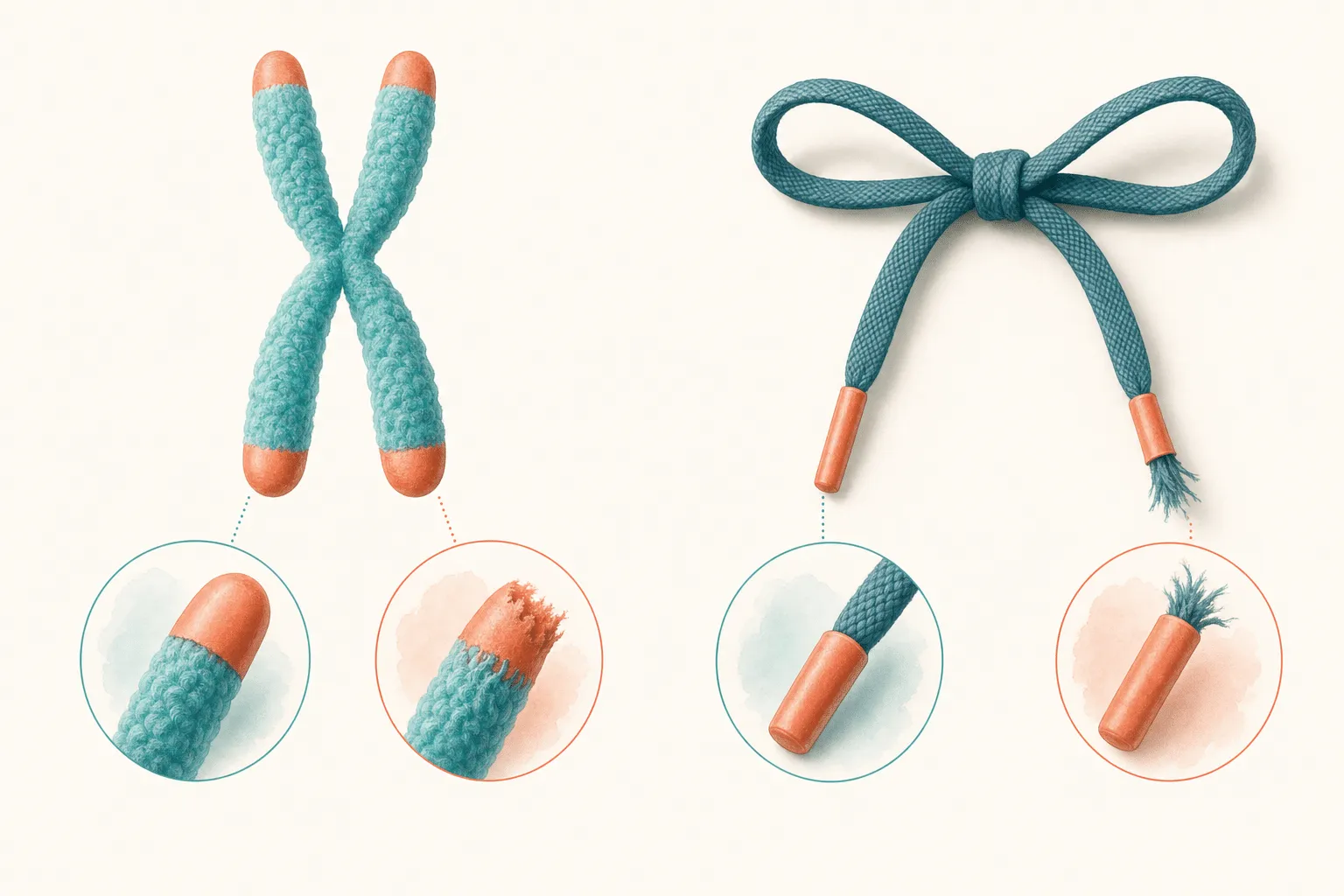
A telomere is a cap of repeating DNA at the end of each chromosome. Think of the little plastic tip on a shoelace — without it, the lace unravels. Every time a cell divides, its telomeres get a little shorter. Eventually they’re too short for the cell to divide, and it dies — and its DNA is no longer functional. We offer a test to measure telomere length and look at ways to slow that clock.
What Researchers Track
The hallmarks of aging
Modern research points to a handful of cellular changes that drive aging. Most of them can be measured — and influenced.
Genomic instability
Telomere attrition
Epigenetic alterations
Loss of proteostasis
Deregulated nutrient sensing
Mitochondrial dysfunction
Cellular senescence
Stem cell exhaustion
Altered cell-to-cell communication
Chronic inflammation (Inflammaging)
Know Your Real Age
Biological age vs. chronological age
Your birthday counts the years. Your biological age measures how your organs and cells are actually doing. With a simple saliva or blood test, we can estimate the physiological age of your body — then tailor recommendations for supplements, nutrition, exercise, and stress to match what your body needs.
Cellular Energy
Mitochondria: your cellular power plants
Mitochondria are the “powerhouses of the cell” — found in almost every cell, they make the energy each one needs to do its job. With age, mitochondrial DNA loses volume, integrity, and function as mutations and oxidative damage from reactive oxygen species (ROS) build up.
Clinical trials point to oral supplements that may support them — such as L-carnitine, alpha-lipoic acid, CoQ10 (ubiquinone), NADH, N-acetylcysteine, and glutathione. We also offer a blood test to assess mitochondrial dysfunction, which matters because mitochondria supply the energy a cell needs to function.
The Common Thread
Inflammaging: slow-burning inflammation
A hallmark of aging is chronic, low-grade inflammation — Inflammaging. It can be measured through circulating markers like elevated C-reactive protein (CRP) and interleukin-6 (IL-6), and it’s a risk factor for many chronic diseases, including cardiovascular disease.
It’s partly driven by increased gut permeability and a shifted microbiome. Remarkably, the environment’s influence on vascular aging can begin before birth: a parent’s lifestyle during pregnancy can affect the long-term health of their child. Obesity adds to the risk — it drives type 2 diabetes, which in turn raises cardiovascular and kidney disease risk.
Gut Health
Your gut is a control center for aging
Your gut does far more than digest food — it’s the largest compartment of your immune system, it sends chemical messages to the rest of the body, and it helps make important vitamins, including B and K vitamins. A healthy gut flora is largely responsible for the overall health of its host.
The microbiome is dominated by two major groups of bacteria — Bacteroidetes and Firmicutes — and it’s shaped by how you were born (vaginal or cesarean), your early diet (breast milk or formula), your adult diet, and antibiotic use. A big concern with antibiotics is long-term disruption of that healthy flora.
Leaky gut syndrome is when a weakened intestinal wall lets bacteria and toxins slip into the bloodstream — feeding the chronic inflammation behind Inflammaging.
Signs of a leaky gut
Burning or ulcer-like feeling in the gut
Painful indigestion
Diarrhea
Gas and bloating
Low energy from poor nutrient absorption
Common causes
Ongoing stress
An unbalanced, unhealthy diet
Excess alcohol
Frequent antibiotic use
Conditions like type 1 diabetes or heart disease
Regeneration
Stem cells and repair
Stem cells can become other cell types, helping repair tissue and organs. As their function declines with age, the body’s ability to repair itself slows — a key focus of regenerative medicine.
A Hopeful Front
Let’s end Alzheimer’s
In 2023, about 6.7 million Americans aged 65+ were living with Alzheimer’s — rising with age from 5% (ages 65–74) to 13% (75–84) to 33% (85+). Part of the disease involves proteins that glue brain cells together, block transmission, and cause inflammation.
Exercise, sleep, a healthy diet, and staying mentally and socially active all help slow it. TIFAAR provides testing and administers an FDA-approved antibody shown to slow progression by 30–50% — and in some cases reverse signs of the disease — in appropriate patients.
Your Next Step
Ready to understand your own aging?
The science is only useful when it’s personal. Our team can walk you through biological age testing and what it means for you.
Texas Institute for Anti-Aging Research (TIFAAR) · Spring, TX · (346) 443-8165
Medical Disclaimer: This guide is for general educational purposes only and is not medical advice, diagnosis, or treatment. Always seek the advice of your physician or another qualified health provider with any questions about a medical condition. Certain therapies and tests mentioned may be investigational and are not FDA-approved for anti-aging purposes; they are provided under physician oversight with informed consent. Individual results vary.